culture
Interview | Duan Yihong: My Love for the Stage Has Never Changed
After many years, Duan Yihong once again stands on the stage he knows so well, facing the audience, using his commanding theatrical presence to create a universe of his own.
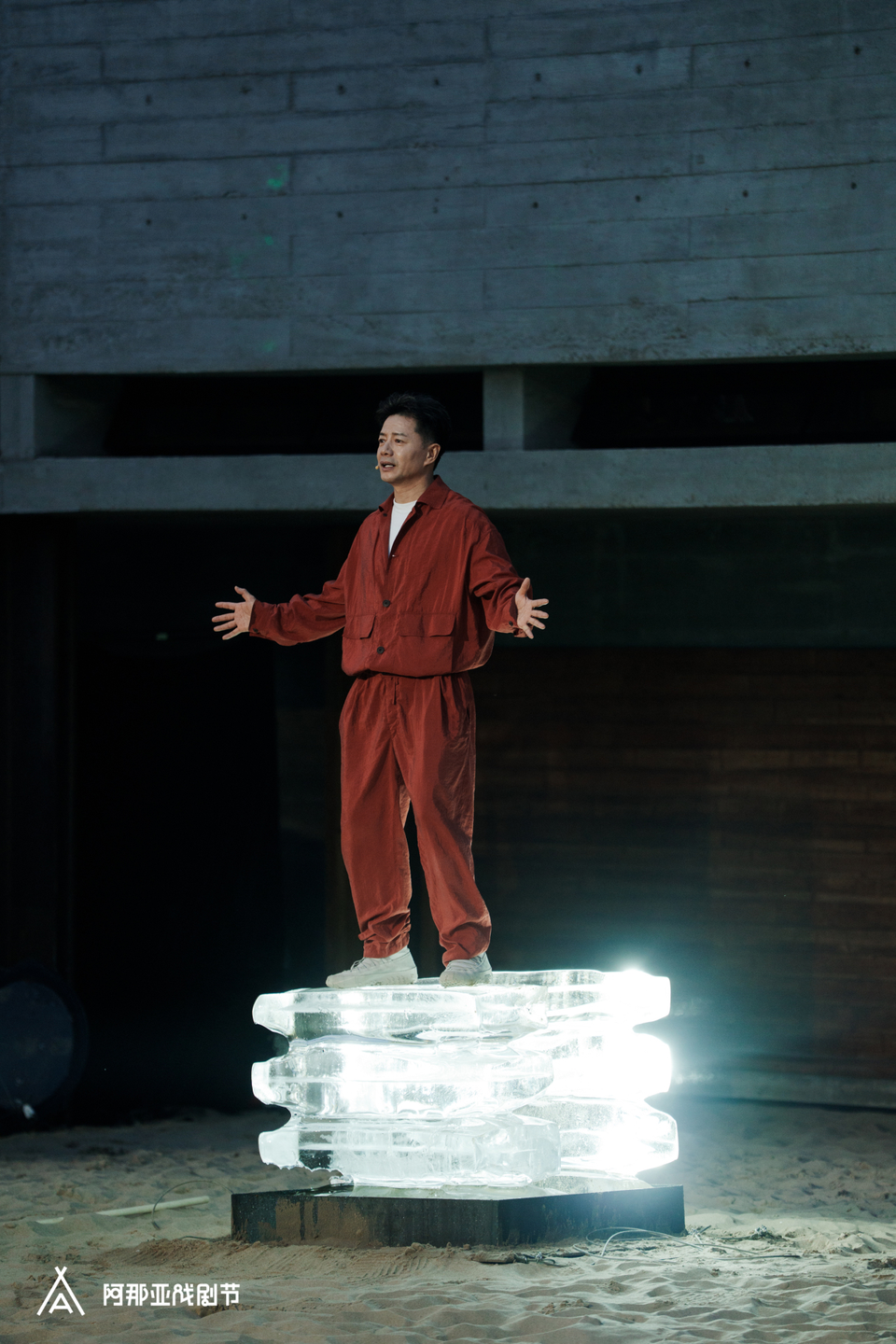
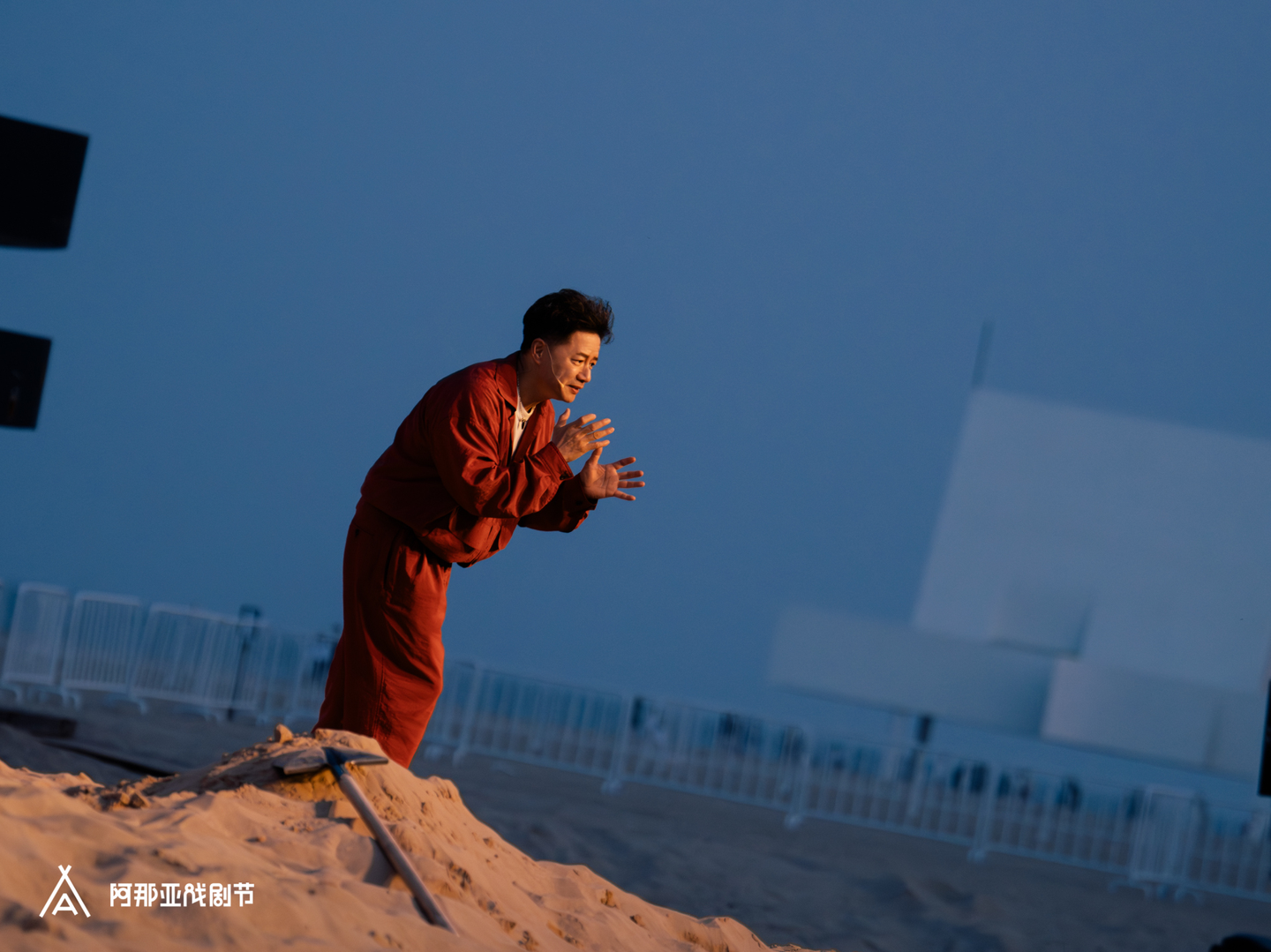
As the light faded with the setting sun on the Aranya seaside, Duan Yihong on the beach only grew more radiant. The ocean stretched endlessly, yet the audience's gaze was involuntarily drawn to him. In a nearly hour-long performance that was almost entirely monologue, more people came to see the actor who has always been captivated by — and belongs to — the stage.
This year's opening production at Aranya, 'Wencheng,' broke out of the theater circle for various reasons. Even before the performance, the fact that Duan Yihong was once again headlining a stage play was one of the hottest topics. The tickets sold out in seconds — owing partly to Yu Hua's original novel, director Chen Minghao's reputation, and Zhou Dongyu's participation, but also because more audiences were eager to see 'Old Duan' perform on stage. Although public discussion later shifted to other aspects amid controversy, Duan Yihong's performance became the most uncontested highlight of the production.
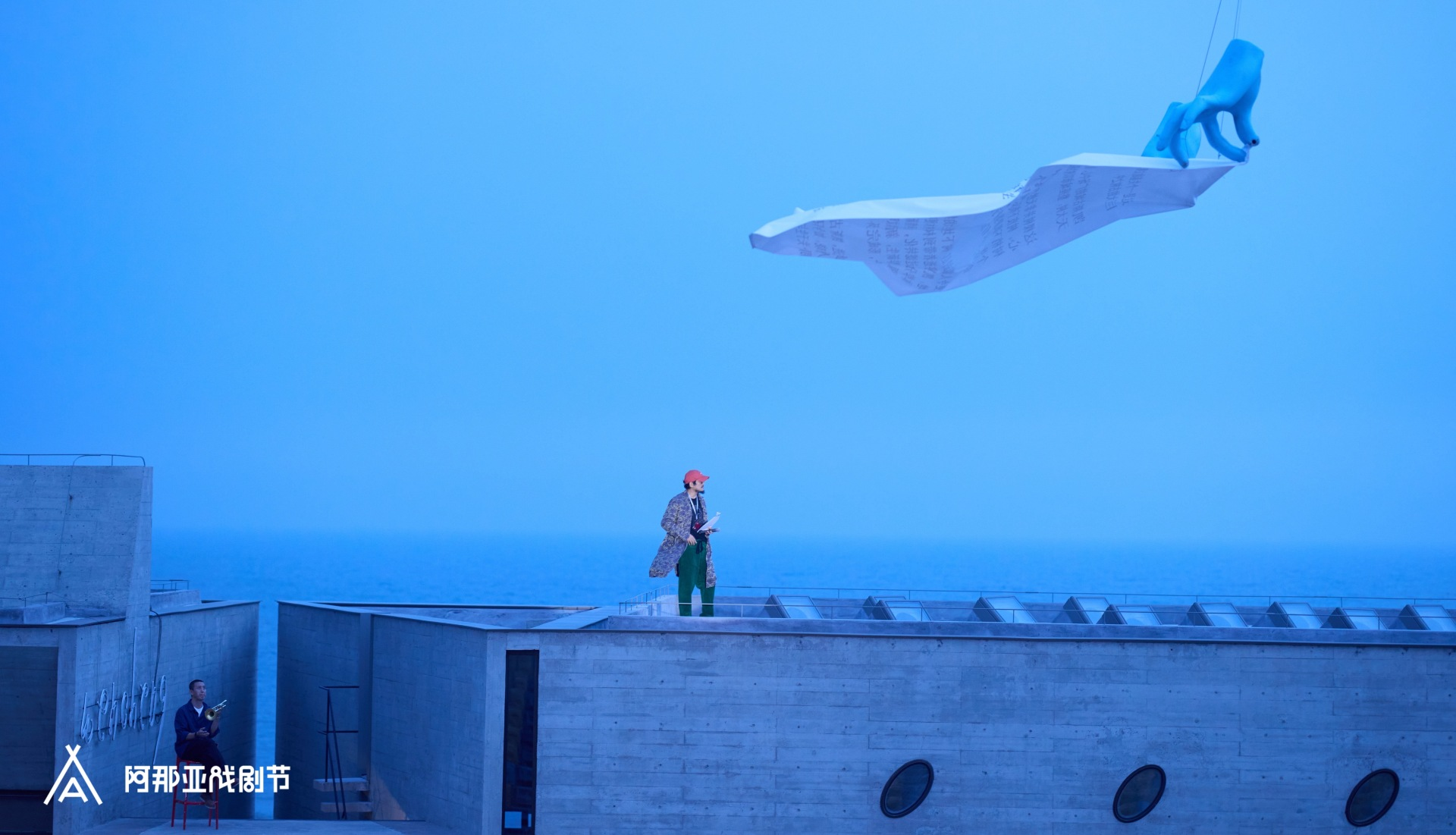
The 'Wencheng' staged at the Aranya Theatre Festival is not the realistic work many audiences expected. Like Chen Minghao's previous attempts at Aranya, this play is somewhat wild and decidedly 'contemporary art.' Beyond the open-air seaside theater that welcomes the setting sunlight, there is a live band, real-time cinematography, and many genuine contemporary art installations. Before the show began, a large crane rig and the seaside solitary library became the monumental backdrop of the performance, creating a visual spectacle.
Duan Yihong plays Lin Xiangfu in the production. In the first half of the performance, Lin Xiangfu almost single-handedly carries the entire work. His entrance involves being packed into a wooden crate, then hoisted by a crane — and when the crate suddenly drops, drawing gasps from the audience, Lin Xiangfu unexpectedly appears at center stage. He then begins to recount, alone, the story of abandoning his home and livelihood to journey south in search of Xiaomei.
There is no conventional plot, let alone any scene with an acting partner. Duan Yihong shapes the character and tells the story almost entirely through monologue and performance alone. In his own interpretation, this work uses a hopeless search to tell a story of unwavering faith and tenderness in chaotic times. 'Lin Xiangfu is unrestrained, romantic, free, and kind. Perhaps more often, he just stands there, and you can feel the resilience inside him — like solid earth firmly supporting himself, yet blooming like peach blossoms with his abundant love.'
Audiences saw the power of performance in Duan Yihong's acting — even without anything else, performance alone can constitute the moving force of a work. In this 'Wencheng,' the performance was full of 'accidents' — shows interrupted by audience discomfort, actors jumping in and out of character — 'improvisation' came without warning, yet became something that shatters illusion. Only actors well-versed in contemporary theater can handle this balance between reality and abstraction and the texture of performance.
And Duan Yihong is precisely an actor who grew up through such theatrical works. More than 20 years ago, he already starred in Meng Jinghui's stage play 'Rhinoceros in Love,' when his name was still Duan Long. As the second-generation actor of this classic play, his version of Ma Lu and Ming Ming alongside Hao Lei is still regarded as one of the most iconic renditions of 'Rhinoceros.'
In previous interviews, both Duan Yihong and Meng Jinghui were candid about their creative conflicts. Meng Jinghui once said of Duan, 'He's too realistic, his bones won't let him float. I want avant-garde expressionism; rehearsals were a tug-of-war every day. Both of us were exhausted, but what came out was unique — no other actor could produce that energy.'
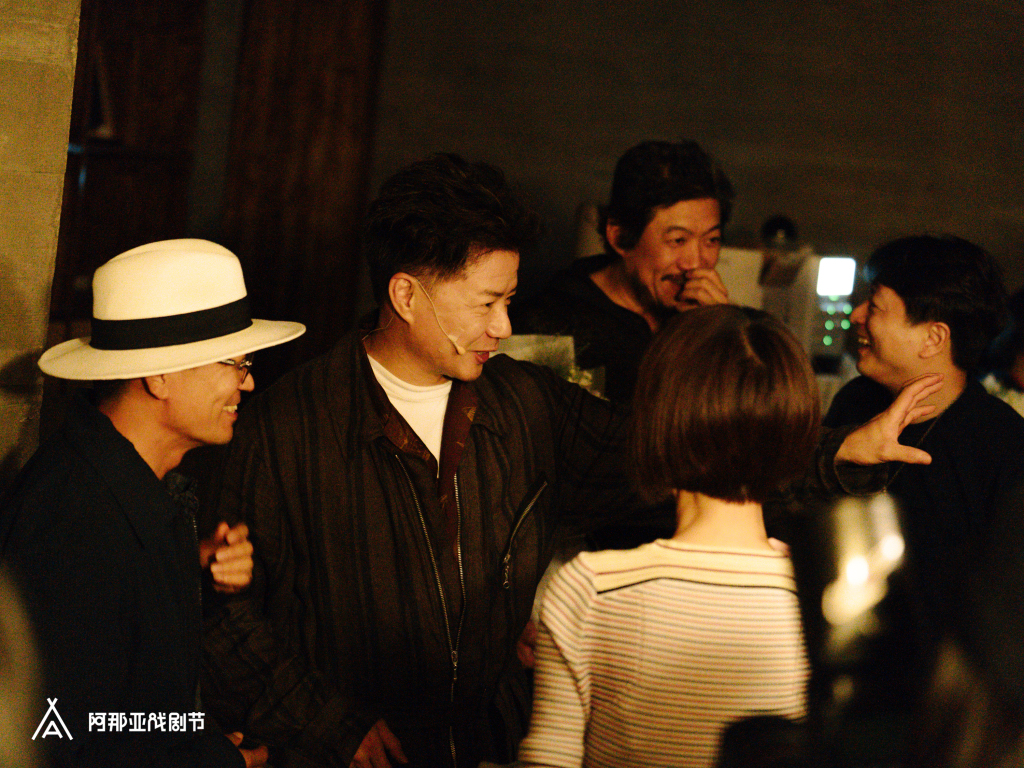
Duan Yihong and Chen Minghao have also known each other for over 20 years. Both are major figures in contemporary Chinese theater. Speaking about his collaboration with Duan, Chen Minghao said, 'Old Duan, we've known each other for 20 years, right? He's intense, this guy is intense. For me, the cost is considerable — you have to work with an actor who insists on pushing boundaries in performance, and let him "scratch" the audience to death. You also need a lot of energy to match him.'
Intensity and stubbornness — this is almost the universal assessment from everyone who has worked with Duan Yihong. The renowned 'theater fanatic,' known both inside and outside the industry, has never changed in over two decades.
During his four years in the acting department at the Central Academy of Drama, he was the only one in his class who never went out to work in film or television, spending all his time on stage exercises. For his graduation production, he starred in 'Equus.' To experience the extreme pain and torment of his character, he spent several days in a psychiatric hospital. This work brought him to the attention of the National Theatre of China, where he eventually stayed. Duan later said the play consisted entirely of long psychological monologues — the breath control and emotional continuity he developed were hard skills that served him for life.
After joining the National Theatre of China, to perform in director Zha Mingzhe's 'Monument,' Duan waited for the role for seven months, becoming so poor he had to ask the theater for an advance on his salary — 90 yuan per performance. But he said the role was worth the hardship. After that, he performed in Tian Qinxin's 'The Field of Life and Death.' Before Yuan Lang in 'Soldiers Sortie' made him widely known, Duan Yihong was always on the stage he loved.
In recent years, as an actor with the National Theatre of China, Duan has continued to perform in stage plays, including 'Four Generations Under One Roof' and 'The Arts during the War of Resistance.' Yet this 'Wencheng' marks the first time in many years that he once again stands at center stage with extensive monologues and solo performance.
In this work, director Chen Minghao — himself an actor — attempts to explore performance with the actors. He told The Paper about his creative vision: 'This production is certainly not traditional performance. It's not traditional life scene depiction or character interaction in a realist sense. I feel those approaches cannot achieve the novel's imagination. How can we, within this limited space, allow the audience to expand their imagination and also believe in these things in their hearts? We hope to de-traditionalize performance in some ways.'
Whether de-traditionalized or traditional, an actor's true skill and strength can ultimately be perceived by the audience. In an interview with The Paper after the performance, Duan Yihong spoke about the significance of the stage to him: 'Stage theater is an indispensable creative sanctuary for me. It is like a guardian that helps me preserve complete, focused creative power — the original intention of sincerely facing characters and audiences through expression, reverence for performance, and spiritual foundation.'
Returning to the stage, Duan Yihong in 'Wencheng' proves once again what he said: 'My love for the stage has never changed.'