technology
Universities Rapidly Establish New Colleges — What It Means for Students Choosing Majors
As college entrance exam results are announced across China, universities have begun intensively releasing admissions materials. The Paper noted that in Wuhan University of Technology's recent WeChat post titled "2026 Admissions Highlights," the school announced the establishment of seven new colleges, including the School of Artificial Intelligence, School of Integrated Circuits, School of New Energy and Electrical Engineering, School of Marine Science and Technology, and School of Future Medical Science and Technology.
According to the university's previous undergraduate admissions materials, it previously had 22 colleges offering undergraduate programs, meaning this restructuring affects nearly one-third of its total faculties — a significant realignment.
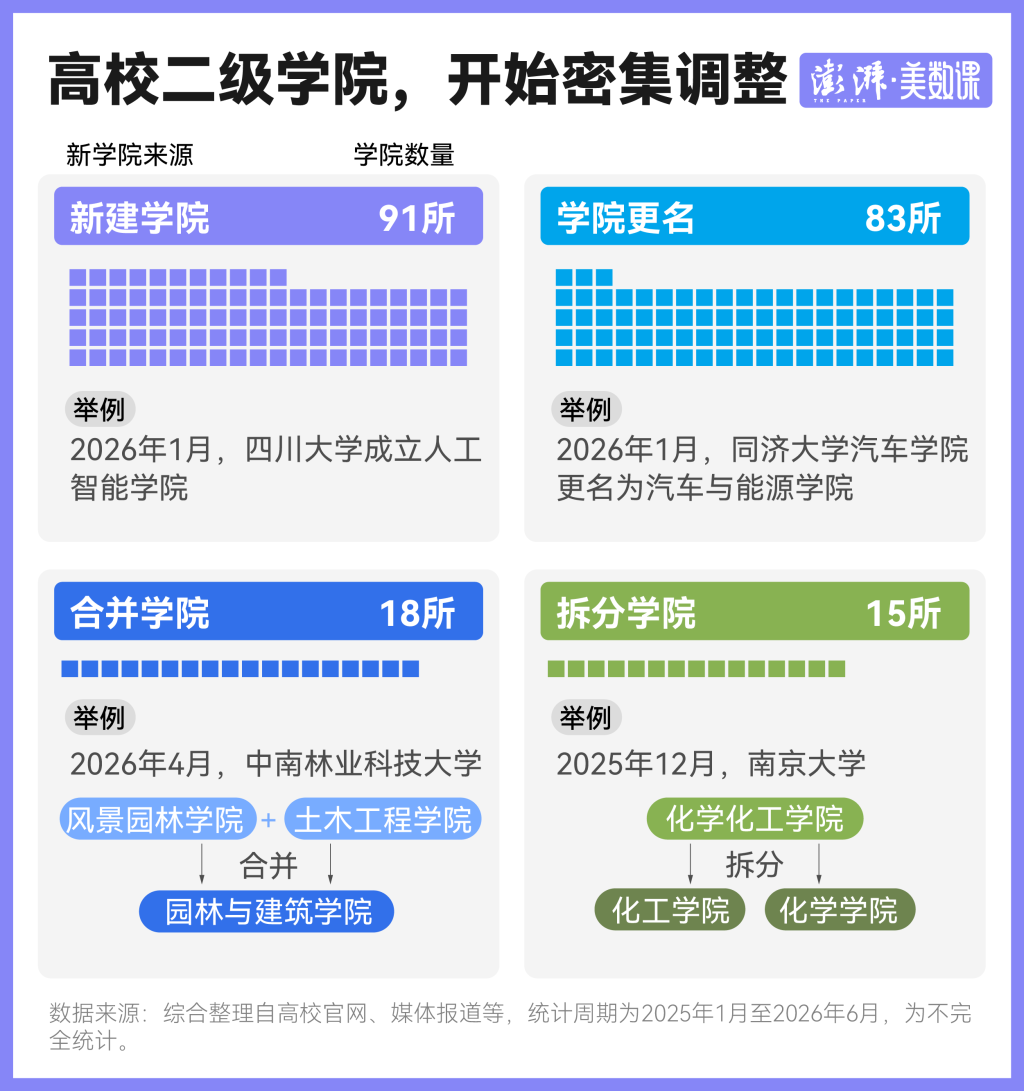
Wuhan University of Technology is far from alone. In recent years, more and more universities have been restructuring their academic departments. According to data compiled by The Paper's Data News Studio, in just the past year and a half, Chinese undergraduate institutions have established over 200 new colleges through mergers, splits, and reorganizations. The School of Architecture saw the most restructuring, while the School of Artificial Intelligence was the most commonly established new entity.
Among the new institutions, AI colleges are the most numerous.
This wave of departmental restructuring is an extension of the intensive adjustment of university majors in recent years.
According to the Ministry of Education, over the past five years, Chinese universities have added 10,200 new undergraduate program offerings while discontinuing or suspending 12,200 — a cumulative adjustment rate exceeding 30%.
By 2026, the pace of change has accelerated further. The "Undergraduate Program Catalog (2026)" released this April shows that the proportion of adjusted programs exceeded 10% for the first time. Among the new programs, AI, intelligent robotics, and digital technology account for over 40%.
Echoing this trend, a wave of new colleges bearing names like "Intelligence," "Robotics," and "Future" are springing up across Chinese universities.
According to The Paper's analysis, among the second-level colleges offering undergraduate programs established after 2025, more than one-quarter have names containing the word "intelligent" (智能), including some at normal universities that were previously seen as primarily focused on liberal arts education.
For example, Anhui Normal University announced in February the establishment of three new engineering colleges at once — the School of Intelligent Information and Advanced Manufacturing, the School of Intelligent Materials and Future Energy, and the School of Artificial Intelligence — adding new engineering programs such as robotics engineering, intelligent manufacturing engineering, and embodied intelligence.
The university explained that this restructuring is a strategic, systematic optimization of its existing engineering disciplines, aimed at "responding to the national innovation system, serving regional industrial upgrading, and optimizing the academic discipline layout."
New Names Reflect National, Industrial, and Academic Development Needs
According to The Paper's observations, many new colleges have been created to align closely with national strategic needs.
Fudan University President and Chinese Academy of Sciences Academician Jin Li revealed in an exclusive interview with The Paper that this year, Fudan plans to launch two more innovation colleges aligned with the national strategies of "Digital China" and "Aerospace Power." In 2025, Fudan had already established six new engineering innovation colleges, including the School of Intelligent Materials and Future Energy Innovation and the School of Intelligent Robotics and Advanced Manufacturing Innovation.
Another motivation for renaming is that, amid the new wave of technological and industrial changes, more and more academic programs are breaking through traditional disciplinary boundaries, making the original departmental divisions no longer suitable.
Take the aforementioned "Undergraduate Program Catalog (2026)" as an example — it added 38 new undergraduate programs covering frontiers such as language intelligence, digital finance, and brain-computer science.
These new programs share a common characteristic: a high degree of interdisciplinary integration. Take "Agricultural Robotics" as an example — it is a new engineering field formed by the intersection of agricultural engineering, robotics, artificial intelligence, mechanical manufacturing, automatic control, computer science, the Internet of Things, and agronomy.
In January this year, Northwest A&F University established the School of Future Agriculture, aiming to "break traditional disciplinary barriers and cultivate talent through personalized, interdisciplinary models."
Beyond aligning with national strategies and promoting interdisciplinary approaches, some colleges have renamed themselves to highlight their development focus.
The Paper noted that in recent years, with the development of the AI industry, a large number of AI colleges have emerged at universities, many of which were renamed from computer science departments.
For instance, the School of Information Engineering at China University of Geosciences (Beijing), established in 1999, stated on its official website: "After years of development, to meet the needs of disciplinary development in the new era and to further emphasize the construction of AI-related disciplines and programs, the School of Artificial Intelligence was officially established in July 2025."
As new technologies like AI develop, programs including foreign languages have been significantly affected. In recent years, some universities have restructured their foreign language colleges.
The Paper noted that multiple foreign language colleges have been renamed, with new names placing greater emphasis on language culture and cultural communication.
Whether studying liberal arts or sciences, this major transformation — led by the construction of new engineering, medical, agricultural, and liberal arts disciplines — is reshaping the boundaries between university departments and colleges.
This poses a challenge for prospective college students and their parents that is entirely different from earlier years: how to find a more suitable major or direction amid constantly evolving disciplinary systems and emerging cross-disciplinary fields?
Judging from the current direction of university adjustments, two major trends are already clear: disciplinary changes closely follow industrial transformation, and interdisciplinary integration has gradually become a consensus.